
- sales@coresolusa.com
- +1(832) 886-0007

In the world of oil and gas, Xanthan Gum for Drilling Fluids plays a crucial role in ensuring wellbore stability, pressure control, and efficient drilling performance. Drilling fluids — often called mud systems — are the lifeblood of every successful well. They cool the drill bit, transport cuttings, control formation pressure, and stabilize the borehole.
At Coresol, we supply oilfield-grade Xanthan Gum trusted by drilling fluid manufacturers, service providers, and operators for consistent performance — even in high-salinity and high-temperature drilling environments.
Xanthan Gum is a natural rheology modifier produced by fermenting carbohydrates with Xanthomonas campestris. This powerful biopolymer provides high viscosity, excellent suspension, and superior flow control — making it an essential additive in modern drilling fluids.
| Parameter | Typical Value / Property | Significance in Drilling Fluids |
|---|---|---|
| Chemical Type | Polysaccharide biopolymer | Natural and biodegradable rheology modifier |
| Appearance | Off-white to cream powder | Easy to blend into mud systems |
| Viscosity (1% Soln, 25°C) | 1500–1800 cP | High thickening power at low concentration |
| pH (1% Soln) | 6.0–8.0 | Stable in neutral pH environments |
| Thermal Stability | Up to 90–100°C | Performs under elevated temperature conditions |
| Salt Tolerance | Excellent | Works efficiently in brine and seawater systems |
| Shear Behavior | Shear-thinning | Thickens when static, thins when circulating |
| Environmental Impact | Biodegradable & non-toxic | Sustainable alternative to synthetic polymers |
| Recommended Dosage | 0.2–1.0% w/v | Cost-efficient performance across formulations |
📖 Data Sources: ScienceDirect, ResearchGate, DOE
Modern oilfield operations demand fluids that are both efficient and environmentally responsible. Xanthan Gum delivers unmatched performance across all key drilling parameters.
Ensures consistent viscosity under varying shear rates and temperature — resulting in smooth mud circulation and efficient hole cleaning.
📖 Source: AIP Publishing – Rheological Stability Study
Prevents barite and cuttings from settling, minimizing downtime and stuck pipe incidents.
Improves gel strength, reduces filtration losses, and enhances wellbore stability.
📖 Source: Thai Science Journal – Xanthan Gum Performance
Integrates seamlessly with bentonite, surfactants, and polymers, improving fluid structure and stability.
Reduces torque and drag, improving drill speed and energy efficiency in horizontal wells.

| Application | Function | Result |
|---|---|---|
| Drilling Fluids (Mud Systems) | Rheology, suspension, viscosity | Improved hole cleaning, stable muds |
| Completion & Workover Fluids | Suspension, fluid loss control | Better formation protection |
| Cementing Additives | Slurry stability, fluid control | Uniform cement placement |
| Hydraulic Fracturing | Flow modification | Efficient proppant transport |
Learn more about our Oilfield Chemical Solutions
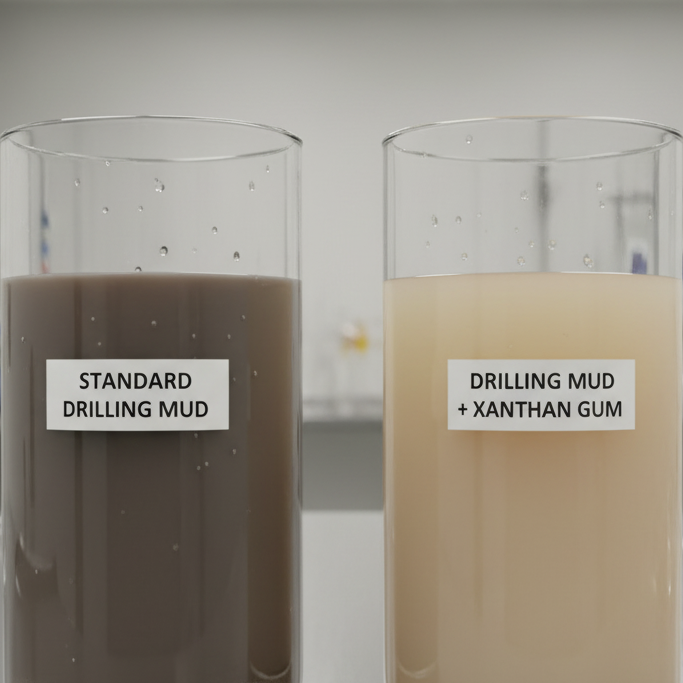
At Coresol, reliability begins with sourcing. Our Xanthan Gum for Drilling Fluids meets strict quality standards for viscosity, dispersion, and purity — ensuring consistent performance in both onshore and offshore environments.
✅ Coresol Advantage:
Explore our Supply Chain Capabilities
📖 Source: Semantic Scholar – Experimental Study of Xanthan Gum in Drilling Mud
As oilfield operations shift toward greener practices, biopolymer-based additives like Xanthan Gum are leading innovation. Its renewable, non-toxic, and biodegradable nature supports eco-friendly drilling without compromising performance.
📖 Source: DOE – Sustainable Drilling Fluid Technologies
When it comes to Xanthan Gum for Drilling Fluids, reliability, purity, and performance matter most.
At Coresol, we ensure a seamless supply chain with transparent pricing and technical guidance tailored to your drilling needs.
📩 Contact Us:
Request samples, pricing, or a technical consultation at Coresol Contact Page.
🌐 Visit www.coresolusa.com to explore our complete Oilfield & Industrial Chemical Portfolio.

Leave A Comment